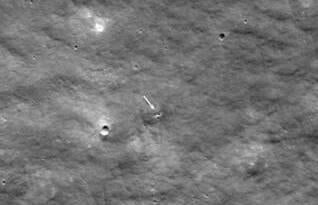
A | Russia's Luna-25 probe likely left a 33-foot-wide crater on the surface of the moon last month when it lost control and crashed down, NASA said Thursday, revealing images that show the suspected impact site.Russia's first moon mission in 47 years ended in failure on August 19 when the Luna-25 probe smashed into the moon after a thruster firing went awry, cutting off communications and putting the spacecraft on the wrong orbital path, according to Roscosmos, the Russian space agency.NASA's Lunar Reconnaissance Orbiter (LRO) spacecraft captured images last week of what the U.S. space agency described as a "new crater" after Roscosmos published an estimate of where the probe had struck.During the descent to the surface on August 19, the Russian spacecraft Luna-25 experienced an anomaly that caused it to smash into the moon's surface. The faiint arrow in this NASA image shows where the agency believes the probe made impact. NASA's Goddard Space Flight Center/Arizona State University "Since this new crater is close to the Luna-25 estimated impact point," NASA wrote in a statement, "the LRO team concludes it is likely to be from that mission, rather than a natural impactor." Moscow has set up a commission to investigate exactly why Luna-25 crashed.The failure was a major disappointment for the Russian space program, which was attempting to up its game amid renewed interest in the moon's southern polar region, where ice deposits may exist in permanently shadowed craters. Ice could offer future space missions a way to produce breathable air, water and even hydrogen rocket fuel.
The Russians have had little success with independent space exploration since the Luna-24 robot landed on the moon in 1976. It scooped up about six ounces of lunar soil and returned it to Earth in Russia's third successful robotic lunar sample return mission.Twelve NASA astronauts walked on the moon a half century ago in the agency's Apollo program, but no Russian cosmonauts ever made the trip. Russia's only previous post-Soviet deep space robotic missions, both targeting Mars, ended in failure.
Former NASA astronaut breaks down India's moon landing04:34Luna-25 was an attempt to pick up the torch and put Russia back into a new space race of sorts, as the U.S., China, India, Japan and the private sector all plan multiple moon missions that could lay the foundations for lunar bases and eventual flights to Mars.India's Chandrayaan-3 Vikram lunar lander made a historic touch-down near the moon's south pole just several days after the Russian probe crashed. It delivered a lunar rover that has already sent back data from soil samples.
B |
暑运期间,儿童乘坐火车出行的数量增加。年满6周岁且未满14周岁的可购买儿童优惠票;年满14周岁,应当购买全价票。但在购票之后,儿童能否单独乘坐火车出行呢?
国铁集团客运部客运管理处副处长 牟宏基:除日常火车通勤上学的学生、经铁路运输企业特殊同意并确认可途中监护的儿童外,未满14周岁未成年人原则上需随同成年旅客出行。
C | 其中,未满6周岁的儿童需要和大人一起检票进站;未满14周岁持儿童优惠票的儿童可以自己刷票进站,但应随成年旅客同行,如果旅客声明该儿童独自出行,铁路部门有权拒绝其单独乘车。
D | 这位负责人解释说,现实情况中,存在个别旅客先购买自己的车票和儿童优惠票后,在乘车前再退掉自己的车票的情形,铁路现行购票规则没有禁止这种操作,但这并非制度漏洞,而是为了方便旅客个性化出行需求。
牟宏基:铁路部门对匹配旅客出行的复杂场景和多元需求进行了充分考量,比如儿童可能会与“为其购票家长”之外的其他成年亲友同行,如孩子的家长为其购票,但不同孩子一起出行,而是由其他同行的购买相同车次车票的成年亲友带孩子出行。铁路部门没有强制要求成年旅客在退掉自己车票时要同时退掉儿童优惠车票,主要是为了方便旅客出行。 铁路部门没有开设全程专人无陪护儿童服务
近年来,不少航空公司推出了无陪护儿童服务。记者注意到,乘坐火车出行没有专人无陪护儿童服务,也不存在“自动托管”“乘务员全程照看”这类服务内容。这又是为什么呢?
国铁集团客运部客运管理处副处长 牟宏基:铁路是大众化交通工具,与民航航班全程客舱封闭、点对点运输、单一行程的模式不同,铁路运输具有站点多、停站短、车厢人员流动性大等特点。列车运行期间,乘务人员需要为全列所有旅客提供在途服务,还要应对各类突发情况,不具备一对一全程看护单独出行儿童的条件,所以目前铁路部门没有设立未成年人专属看护、托管、全程监护等个性化服务。
Current article:http://rnoysdj.bomanglangsugangunxileba.cyou/00q42r/4oo1.html



 国铁集团客运部客运管理处副处长 牟宏基:除日常火车通勤上学的学生、经铁路运输企业特殊同意并确认可途中监护的儿童外,未满14周岁未成年人原则上需随同成年旅客出行。

 牟宏基:铁路部门对匹配旅客出行的复杂场景和多元需求进行了充分考量,比如儿童可能会与“为其购票家长”之外的其他成年亲友同行,如孩子的家长为其购票,但不同孩子一起出行,而是由其他同行的购买相同车次车票的成年亲友带孩子出行。铁路部门没有强制要求成年旅客在退掉自己车票时要同时退掉儿童优惠车票,主要是为了方便旅客出行。 铁路部门没有开设全程专人无陪护儿童服务
近年来,不少航空公司推出了无陪护儿童服务。记者注意到,乘坐火车出行没有专人无陪护儿童服务,也不存在“自动托管”“乘务员全程照看”这类服务内容。这又是为什么呢?
牟宏基:铁路部门对匹配旅客出行的复杂场景和多元需求进行了充分考量,比如儿童可能会与“为其购票家长”之外的其他成年亲友同行,如孩子的家长为其购票,但不同孩子一起出行,而是由其他同行的购买相同车次车票的成年亲友带孩子出行。铁路部门没有强制要求成年旅客在退掉自己车票时要同时退掉儿童优惠车票,主要是为了方便旅客出行。 铁路部门没有开设全程专人无陪护儿童服务
近年来,不少航空公司推出了无陪护儿童服务。记者注意到,乘坐火车出行没有专人无陪护儿童服务,也不存在“自动托管”“乘务员全程照看”这类服务内容。这又是为什么呢? 国铁集团客运部客运管理处副处长 牟宏基:铁路是大众化交通工具,与民航航班全程客舱封闭、点对点运输、单一行程的模式不同,铁路运输具有站点多、停站短、车厢人员流动性大等特点。列车运行期间,乘务人员需要为全列所有旅客提供在途服务,还要应对各类突发情况,不具备一对一全程看护单独出行儿童的条件,所以目前铁路部门没有设立未成年人专属看护、托管、全程监护等个性化服务。